

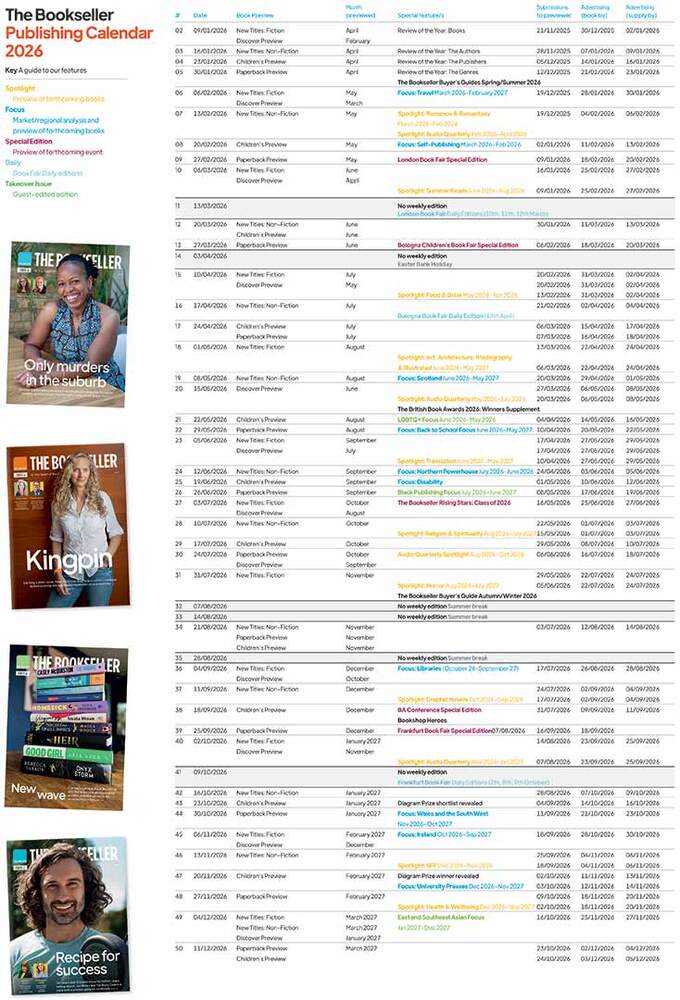



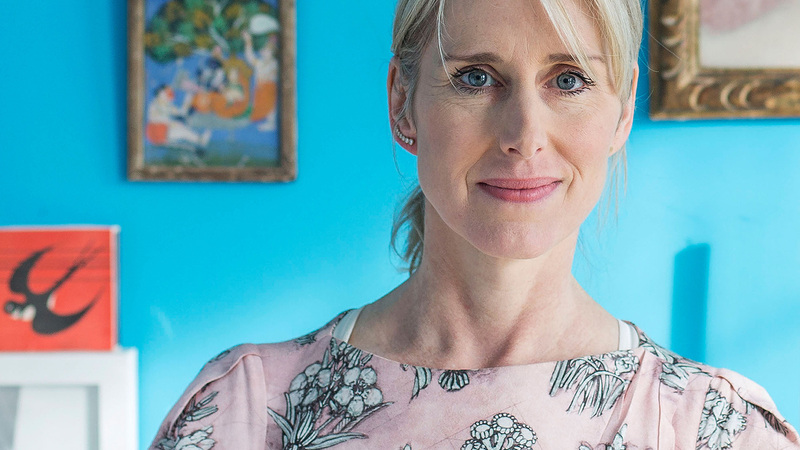
Books in the Media: Charlie and Lola await Christmas in Lauren Child's latest



This week, two children’s books are in the limelight and a novel, published for the first time in English, is welcomed by the Sunday Times.
In children’s books, the Telegraph’s Emily Bearn selected I Am Wishing Every Minute for Christmas (Simon & Schuster) by Lauren Child. In the picture book, elder brother Charlie must invent new ways to distract his younger sister Lola to make time pass more quickly in the lead-up to Christmas. “The contrast between Lola’s impetuousness and Charlie’s scrupulous pragmatism provides each story with a sense of moral certitude,” wrote Bearn. Child’s “ear for her childhood dialogue is equally distinctive, with many of the stories making a feature of Lola’s grammatical idiosyncrasies”. The book will “resonate with every young reader,” concluded Bearn.
The Times’ Lucy Bannerman reviewed Luke Palmer’s Live (Firefly), “the story of a group of sixth-formers who have to rebuild their friendships after a beloved member of their band is killed in a car crash”. The novel “may strike the right note” for teenage boys “who are not into fantasy or sci-fi", noted Bannerman. The “cinematic, slo-mo shot of the accident” is “repeated throughout the novel, one of several experimental flourishes that marks Live out from standard YA fiction”. Live explores grief as band member and friend George sends “long rambling messages to my dead friend’s phone”. Bannerman noted: “It becomes a diary, as George tries to make sense of everything that has happened, grieving for a friend while at the same time embarking on new love and the next, exciting stage of his life”.
Danish author Inger Christensen’s 1988 novel Natalja’s Stories (Penguin Classics) “is best understood”, the Sunday Times’ Ceci Browning said, “through comparison with the works of the Russian artist Wassily Kandinsky: immersive and contemplative abstracts with no clear centre, the kind of paintings that get hung on the wall upside down”. Translated by Denise Newman and published for the first time in English this month, the novel is “told in seven stories through which we meet four generations of women, each darting round Europe according to political tides and suitors’ movements”. Browning described the book as “twisty and original, but it was [Christensen’s] strange vignettes that stayed with me for days… If Natalja’s Stories were a painting, I’d probably still be standing in front of it”.
Continues…
Read More
Helen DeWitt’s latest novel, Your Name Here (Dalkey Archive), co-written with journalist Ilya Gridneff, was described by Gabrielle Schwarz at the Telegraph as a “thrillingly strange 600-page novel-within-a-novel-within-a-novel” that “explicitly” confronts “the circumstances of her career”. Schwarz explained: “This isn’t the easy read you might find at the Stansted airport branch of WHSmith… And why shouldn’t there by a space in the market for books that are difficult, yes, but also fun and exciting and provocative – not least because they’re trying something different?” The novel includes “fragments of what appears to be an idiosyncratic Arabic textbook” – an idea taken from DeWitt’s The Last Samurai that “an ‘airport novel’ could serve as a Trojan horse for teaching languages to readers”. The review continued: “Much of the rest of the book consists of email exchanges and occasional in-person meetings between DeWitt, Gridneff and their professional contacts… It’s all oddly gripping – especially if, like me, you’re the kind of person who is tantalised by the prospect of peering into a stranger’s inbox.”
“Capitalism: A Global History is an exhaustive and exhausting economic history of the last thousand years, told by distinguished Harvard historian Sven Beckert,” stated John Kay at the Financial Times. Published by Allen Lane, the book opens “in 12th-century Aden and ends… in 21st-century Cambodia” and reflects a “correspondingly wide” selection of sources. “Read this book and you will learn innumerable things you did not previously know culled from places you have never been,” reported Kay. “You may also feel there were some events you did not need to know about and places you will not trouble to visit. But others, including me, will be genuinely grateful for exposure to this breadth of scholarship and be glad to have a valuable tool of reference on their shelves.”