





You are viewing your 1 free article this month.
Sign in to make the most of your access to expert book trade coverage.
Trade feels the strain in run-up to Christmas as printing firms hit capacity
The book trade is showing signs of strain under the onslaught of titles in the all-important build-up to Christmas, with printing firms jam-packed, reports of warehouse delays at Amazon, and some delivery issues for bookshops.


The book trade is showing signs of strain under the onslaught of titles in the all-important build-up to Christmas, with printing firms jam-packed, reports of warehouse delays at Amazon, and some delivery issues for bookshops. Fears of more lockdowns on the way, as the Covid-19 pandemic quickens its pace again, are also adding to the pressure on publishers and retailers.
In the US, financial woes at printing giants Quad and LSC, alongside a surge in demand, has led to backlogs, with long waits for reprints and delays in books hitting shelves. Though the UK has avoided that crisis, printing firms Clays and CPI told The Bookseller this week that they were running at full capacity as hundreds of new titles rolled off the presses, with orders up by around 30% on the same time last year.
“It’s an extraordinarily busy year, it really is genuinely unprecedented,” said Clays m.d. Paul Hulley. “I’ve never seen anything quite like it, which is fantastic news for us and for the industry, but we’re certainly having to work through it in a way we wouldn’t normally have to, just in terms of making sure we still get books to market when the market needs them.”
There have been concerns raised that, with such a crammed schedule, any need for reprints would mean delaying the printing of new titles. Hulley admitted that was an issue, but said the same applied during peak times in previous years. He said: “We are very busy but we’re working with our publishers, as we said we would, just to hit our priorities.”
Tanya Dunbar, CPI’s UK divisional m.d. for trade books, said this side of the Atlantic had avoided the “insane” lead times seen in the US recently, with waits reported of six to eight weeks for a reprint. With a lack of US printing capacity, some American titles are being printed elsewhere, but Dunbar said her own firm had hardly any capacity to take them on—and that the situation was mirrored in much of Europe, too.
Capacity constraints
Dunbar said: “We’ve been asked to do quite a few [US books] but to be honest, because of the capacity constraints we’ve got with the UK market, we haven’t really been able to benefit much from it. We had a few titles and we have got one publisher who made the decision about a year ago to move all of their US work here, so they were ahead of the curve. We’ve had a couple of opportunist titles that we said we’d take because we could just squeeze them in, but what I haven’t been able to do is take work on and jeopardise the agreements we have with our UK publishers.”
Dunbar said her company had slightly reduced capacity owing to social distancing measures, but had been in close contact with publishers since the start of lockdown to make sure needs were met.
“There’s not been a collapse, certainly not here,” she said. “It’s been well managed, although we can’t take on any more. We are managing what we have got as closely as we can, and if we are needing to move dates around, we are doing it ahead of time rather than missing dates and not delivering. It’s been quite an operation, but good. I’m really pleased with how everyone here has reacted.”
Alongside jostling for space in the printing schedules, some publishers looking to get their books to readers have reported the added headache of “backed-up” deliveries and even shipments being turned away from packed Amazon warehouses. The facilities are understood to be running at fuller capacity after the retailer shifted its Prime Day event to 13th and 14th October.
One publisher reported being told Amazon at one time needed to restrict book deliveries to boxes instead of pallets. Another anticipated sales of “Super Thursday” releases would have been affected, and said there was “some anxiety among publishers that many books will appear to be out of stock on publication day”.
However, they admitted the retailer had reacted quickly and they had the impression Amazon largely now has the situation under control. “It’s such an important sales season —particularly this year—so all publishers are very jittery,” they said. “While it was a bit of a shock to discover there was a possible serious hitch at Amazon, it’s good to find that they have got to grips with it now. Of course I expect all publishers will be keeping a very close eye on it for the rest of the autumn and Christmas season.”
Amazon declined to comment on publisher shipments being turned away, but it is understood its books team has been working closely with publishers in recent weeks to try and mitigate repercussions of the Prime Day date change. The company has been focused on improving customer availability messages wherever possible while monitoring the situation, and it is currently continuing to accept inbound products. A spokesperson for the retailer said: “Books are very important for our customers. Our priority remains to protect book availability and we will do our best to deliver customers’ books on time.”
Indie booksellers, too, have faced problems with late or incorrect deliveries as warehouse staff working under social distancing measures attempt to send out more books than ever. While some shops reported things were going smoothly, one bookseller, speaking anonymously, said the situation was gradually getting worse, with accurate deliveries becoming increasingly “sporadic”.
Another, Paul Drake, who runs Drake– The Bookshop in Stockton-on-Tees, said there were problems “almost across the board” in distribution, although he particularly praised the efforts of Hachette and Gardners, which this week made the welcome announcement that it had reopened the Norwich warehouse it obtained after acquiring the assets of Bertrams.
Drake said: “There’s a fairly large element of it that’s understandable. There is also a slight frustration in that we have books we have cancelled arrive at the shop, and we have books we ordered that arrive two or three weeks late, and things that we’ve ordered that have been stuck in the system somewhere from June that arrive at the end of September.”
He added: “No one has done any of this deliberately, and I appreciate that, but it’s a problem of nine months’ worth of books crammed into six months, and fewer people in warehouses. There’s no malice intended but at the same time, ultimately we’re standing in front of a customer who is saying, ‘You told me it would be here today’, and it’s going to be another X days, or it’s got lost in the post.
“I’m not for a moment saying all deliveries are dreadful. But bear in mind it’s only the first week of October, so in theory Christmas shopping hasn’t started yet, and there are issues in the pipeline. It feels like there’s only one direction it’s going at the minute.”
Alarm bells
With the national lockdown still fresh in the trade’s mind, the spectre of another, or simply more local restrictions, has also set alarm bells ringing. Stephen Lotinga, c.e.o. of the Publishers Association, said such a prospect would be “very damaging” for the industry.
“Many publishers continue to defy expectations, but if there were a return to a closure of bookshops in the run-up to Christmas, that would be a cause of great concern, although the safety of staff is paramount and must, of course, guide these decisions,” he said. “Covid has placed real pressures on university and school budgets, and further lockdowns will only exacerbate that. The government must ensure that institutions have the funding they need so that every student can access high-quality learning resources, regardless of whether [or not] they are in the classroom.”
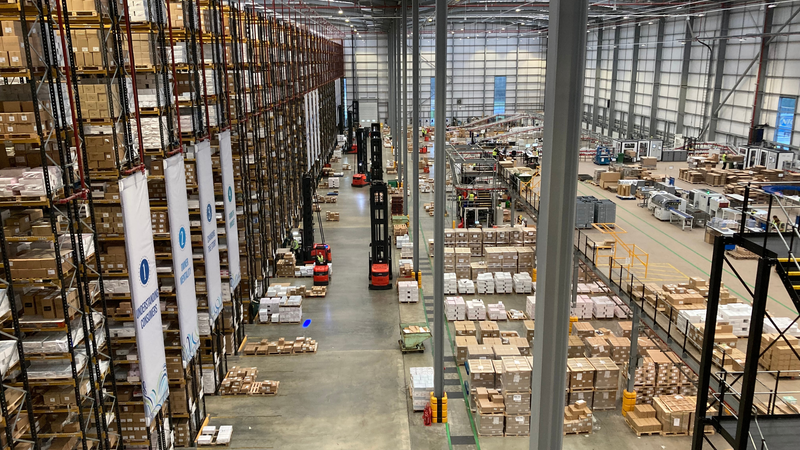
However, David Shelley, c.e.o. of Hachette UK, said his own firm had “learned some valuable lessons” from the national lockdown and was prepared for a wide variety of scenarios that might affect the supply chain. He said: “Our state-of-the-art distribution centre, the Hely Hutchinson Centre, runs an innovative goods-to-person system that enables us to maintain a safe working environment, with social distancing, and we are also prepared to run extra shifts this year if needed, including overnight from September to December.
“Our sales team is also working constructively with customers to anticipate demand—for example, by presenting key titles much earlier and managing forecasts dynamically to maintain availability of books. We are also supporting the high street booksellers with signed editions and other special editions.
“We know now that things could change at any moment, but we are confident we will be able to react swiftly to any potential changes in government guidance.”