
You are viewing your 1 free article this month.
Sign in to make the most of your access to expert book trade coverage.
The bookshop bigwig chats about his Barnes & Noble tenure, the democratisation of chain stores and why public libraries are vital to the bookselling ecosystem.
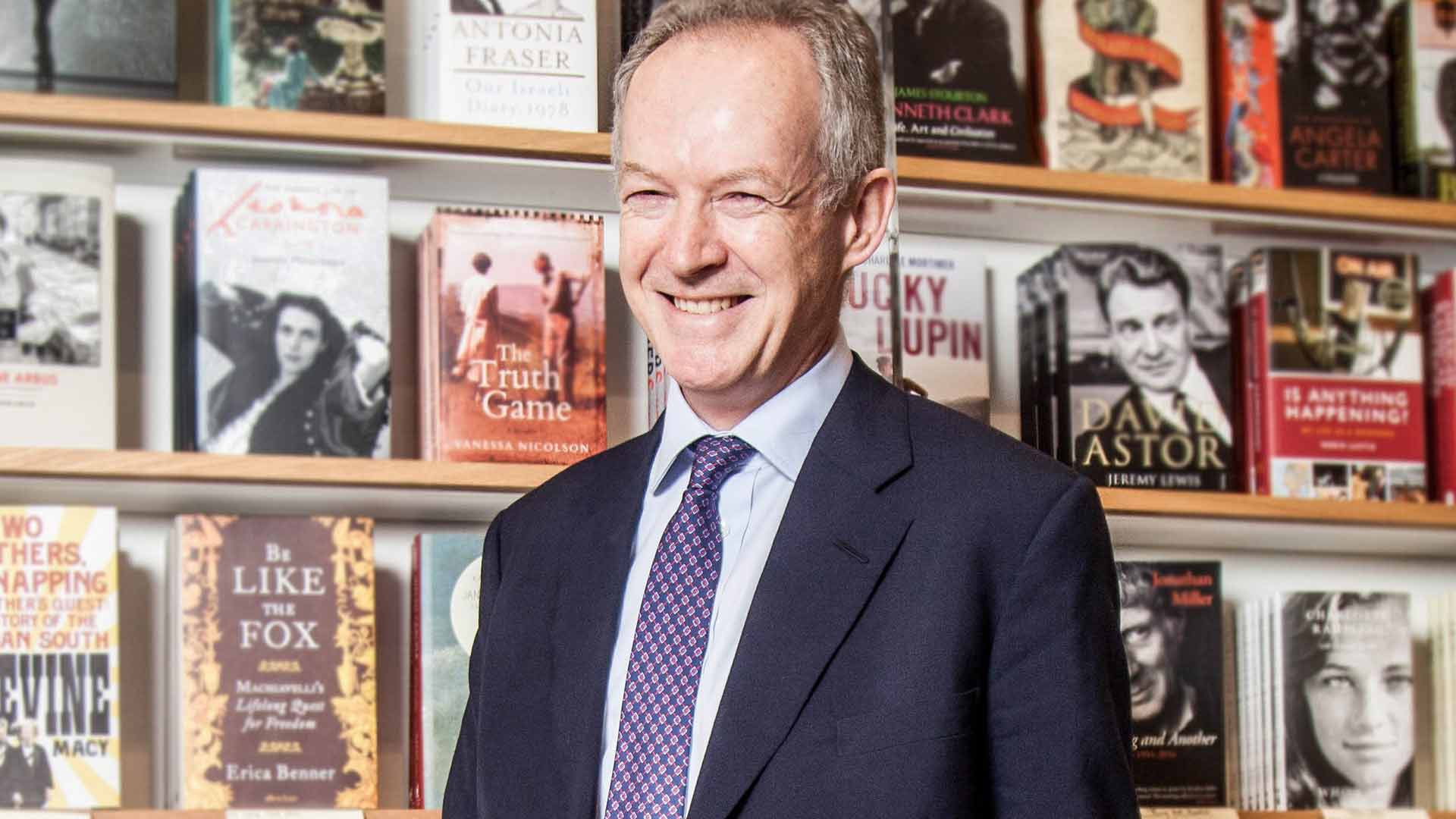
James Daunt came to America in September 2019 to run its biggest bookstore chain, Barnes & Noble (B&N), which was flailing and likely heading towards failure, and to do so while still running the UK’s largest bookstore chain, Waterstones, which he was credited with having saved from a similar fate after arriving there eight years earlier. From his light-filled, modest corner office at B&N’s very slimmed-down, open-plan headquarters off Union Square in New York City, Daunt recalls that for the decade from 2010 to 2020, B&N opened 25 stores and closed 130.
Fast forward exactly six years since he started the job. On a wall near Daunt’s desk is a large map of the US with dark yellow pins stuck into it, marking all the places where Barnes & Noble currently operates stores in this vast country. Now, new pins are being added – this year alone, around 60 – and the plan is to continue to add more. Both Waterstones and B&N, under Daunt’s leadership and the ownership of Elliott Advisors, appear to be flourishing. “You don’t open 60 shops for free,” is how he puts it, and this when uncertainty on the macro scale is swirling like a hurricane all around us. The Bookseller decided it was time to catch up with the single most important bookseller in the English language (sorry, Mr Bezos, not you).
Daunt is in America three weeks out of every four, often travelling far from New York to visit stores. One week is spent in Britain (where he also stayed during the Covid-19 pandemic). He sees his job as “putting in the infrastructure that allows the shop teams to run themselves, trying to give guidance principles. It’s impossible to run all the stores one way. It doesn’t work, but that’s what my predecessors did”. (After B&N’s remarkable founder, Leonard Riggio, stepped back, a slew of CEOs came and went; decision-making was always highly centralised.)
Before taking over at Waterstones, Daunt, the son of a diplomat, had briefly been a banker, then founded the eponymous London indie chain Daunt Books that now extends to six stores, including one in Oxford, so he “had the advantage of knowing how bookstores run. And how you run them involves the same things, whether it’s here or London or Tokyo or Taipei – the visual aesthetic, having the right books, getting the backlist sorted, selling a lot of things that make sense beside the books, etc. I’m here to write the cheques that need to be written. Developing teams within the shops requires a lot of time and investment. In a team, you must constantly ask yourself what you’re doing – it’s your store, after all”.
It’s easy to lose sight of how extraordinary chain stores are. They are very democratic. All walks of life come in, and if we do it really well, it should be a source of great pride
The chain runs on a “cluster structure” of four or five stores, with individuals responsible for key elements. Training develops support within that cluster; for example, somebody in each is responsible for visual merchandising, another person for operations, another for social media, and so on. It is all local, “so if any one store has a problem, they know who to go to, and we know who’s responsible. There is clear accountability. We get the good stores to help the bad ones. Very few people can master all the skills, so we split them into the component parts. There’s an increasing understanding about what we’re here to achieve, and we do it differently in every location”. B&N currently has 17,000 booksellers – an increasing proportion of them full-time; Waterstones has 4,500.
The latter is “much further along in its evolution than B&N; we’re only about four years into it here, because of the pandemic, so we are where Waterstones was in 2015/16, but we’re following a similar trajectory and have made huge progress. If you run a better store, communities really value the place, and you sell more. We live in a metro bubble and it’s easy to lose sight of how extraordinary chain stores are. They are very democratic. All walks of life come in, and if we do it really well, it should be a source of great pride”.
When asked about the future, given the level of global and economic uncertainty hanging over us, Daunt replies: “I’m very, very long in the tooth, and have been through recessions. Books are an interesting product to sell in hard times. There can be expansion, because the property market opens up. After the demise of the Bed Bath & Beyond chain, we got a lot of their properties. In a recession, if you’re expanding, it’s not bad. If our sales keep up, it’s not bad. Books, relatively, are low price. As long as we run really good stores, places of solace and refuge, very good times are almost more challenging: all the costs – property, wages – go up, but sales go up and down. Right now, in the Livingston Mall in New Jersey, all the stores have closed except us. There’s a mall in Tucson, Arizona being demolished, but we’re still there, and trading well. We are a community retailer: there’s incredible strength in that.” As for Trump’s tariffs: “They have less impact on bookstores because lots of books are printed in America, although there is an inflationary impact on non-book product.”
Queried as to whether it is all romantasy, fantasy and TikTok driving sales, and if that bubble will burst, Daunt responds: “You could ask that question every single year of my bookselling life. Nobody’s buying anything but, say, soft porn (Fifty Shades of Grey), or vampires (Twilight), or Harry Potter, or romantasy. There’s always a bubble about to go pop; publishers are always wailing that the world is about to end. The reader moves around, and I don’t have to anticipate what the trends will be.”
Continues…
Daunt adds: “Yes, there is a problem with non-fiction sales because the world is really distracting and interesting right now. Life hasn’t calmed down since the last election, and a significant part of the readership is locked into current events and not buying books in the usual quantity.” Tellingly, the newsstand part of B&N’s business “has shot up”.
Daunt maintains that he is “totally uninterested in trying to compare this year’s sales against last year’s. But books will catch up – they always do. Our customers will come back. I’ve been preaching caution for some time, and know that on this side, we’ll still sell, but there will be changes in the amount. Our publishing colleagues cry that the political book is dead, but look at sales of the Kamala Harris book [107 Days]”.
People have not returned fully to events the way they attended them pre-pandemic, but the big ones “are going fine”. In the huge B&N Union Square mothership, Kamala Harris’ book signing sold out, so the store put on a second event, and that sold out, too. “Events are like a muscle that has had to be retrained,” Daunt says, then pivots: “I’m more interested in talking about children’s story time.” For it is the kids’ section “that is the core of any store”, he emphasises. So much has been bruited on both sides of the pond about a crisis in reading, especially middle-grade reading, but Daunt takes “a long-term view. I’ve been told forever about this crisis. What’s astonishing is that I don’t think there’s a parent who doesn’t believe that a child’s prospects aren’t improved by reading. I see an enduring respect for it, and not just within the middle class. Our middle-grade sales haven’t gone down – they’ve changed. Our returns rates on hardcovers were astonishing; we take in less now, and sell more softcovers. We’re bursting out of our kids’ sections – that’s a very strange thing to be happening to a dead category”.
One of the problems he identifies in the industry is “the creation of new authors, brands, and bestsellers. We’ve had an ossified list of bestsellers. It changed in the UK and we’re in the process of changing it here. The creation of new authors had dried up. Now, we have Katherine Rundell, a creation of physical bookshops, and she is massive for us. Or look at Mona’s Eyes [Thomas Schlesser], from Europa” – the book was very visible in the Union Square store – “that is the work of physical bookshops. I don’t think if we win, [Amazon] lose, but better bookshops are selling more books”.
Libraries matter more than we do. We feed off engagement with literature, and when you get politicians who are messing with libraries, that’s not good
The subject turns to censorship. Daunt acknowledges that suppression is occurring both in the US and Britain. However, he “won’t accept the hypocrisy of saying that it’s happening only on one side. We sell without grace or favour. I sell Harris’ book, and books on the right. We sell books on Gaza, Palestine, Israel, Zionism. We will cover all”. There is, he admits, “a certain number of people being unpleasant, but we know how to navigate it amid the social media culture wars. If we stay true to our core principles we may be in the cross hairs, but need to keep calm and be sensible”.
From censorship we segue to libraries. “They matter more than we do,” Daunt says, categorically. “We feed off engagement with literature, and when you get politicians who are messing with libraries, that’s not good. The UK has underinvested in public libraries for such a long time, it is most appalling. And then there are the public schools in the US lacking libraries. We matter, but they matter more.”
What will happen when he gets tired of traversing the Atlantic, or Elliott gets tired of owning bookstores? “Well, Daunt Books has not looked back, and Waterstones has gone from strength to strength – slightly rude of them, don’t you think?” He smiles. “But the stores will continue, because of the nature of the work. It didn’t used to be the case. Now people join the companies as a bookseller, they don’t come from Staples or GNC or somewhere else. They work their way up. I don’t run the companies from the top down; succession is embedded in the management model. We’re a tribe! We have Zain Mahmood, who ran books online at Waterstones, who came over, and now runs our books team here, and is an exceptionally good bookseller. We will have more such transatlantic movement.
“We’re also in a very good place with the big publishers as partners, whereas in the past, there was lots of turmoil with B&N.” As for the owners: “Elliott will sell us at some point – when they sell will be a function of what the markets are up to, the right moment. They have been very good, and took us through Covid-19 exceptionally well. It’s all been about growth, which suits me down to the ground.”
The US’ indies openly express ambivalence towards Daunt. They remember the bad old 1990s, with the relentless march of the B&N superstore rollout, followed by the double whammy of Amazon and e-books, and all the individual stores that shuttered. True, after the Riggio formula got old and Amazon loomed over everything and it looked like B&N would fail, attitudes changed: B&N had to survive as a bulwark against Amazon, and Daunt, who had been one of their own, was welcomed.
Now, with B&N expanding again, indies complain that some of the new stores being opened are sited in locations too close for comfort, targeting the businesses of existing bookstores. Some also grumble about the addition of iconic indies Foyles and Blackwell’s in the UK, and Tattered Cover in the US, to Elliott’s portfolio. Referring to the latter, which was in bankruptcy proceedings, Daunt says: “It was a tragedy the stores had got themselves into that situation, and so much better that they are here, rather than disappeared.” Reflecting for a moment with a wry smile, he adds, “I’m trying to nudge all these things along. I’m the nudger.” The smile almost turns into a grin.
“If you were to replace all the bookstores that have closed, we’d be opening about 60 for each of the next 50 years,” he muses. Having just celebrated his 62nd birthday, he will not be around quite that long, but looking at the big picture, no one can deny the good he has done. Beneath the buttoned-up-English-gentleman exterior is an extraordinary energy and compelling passion married to clear-sighted business sense. Daunt, more than anything, is an evangelist for books, reading and bookselling, and is not done fulfilling his mission just yet.