



You are viewing your 1 free article this month.
Sign in to make the most of your access to expert book trade coverage.
Why the publishing industry must back small presses, rather than LLMs.
I’m writing to make the case to you, the wider book industry, that small-press publishing is important. I imagine this almost as if you are judges, perhaps peering over stacks of bestsellers, and I am one of the defendants. Why is that? Because really the situation is this: the industry is not supporting small-press publishers enough, not because it ought to, but because small-press publishing is the future of book production in this country.
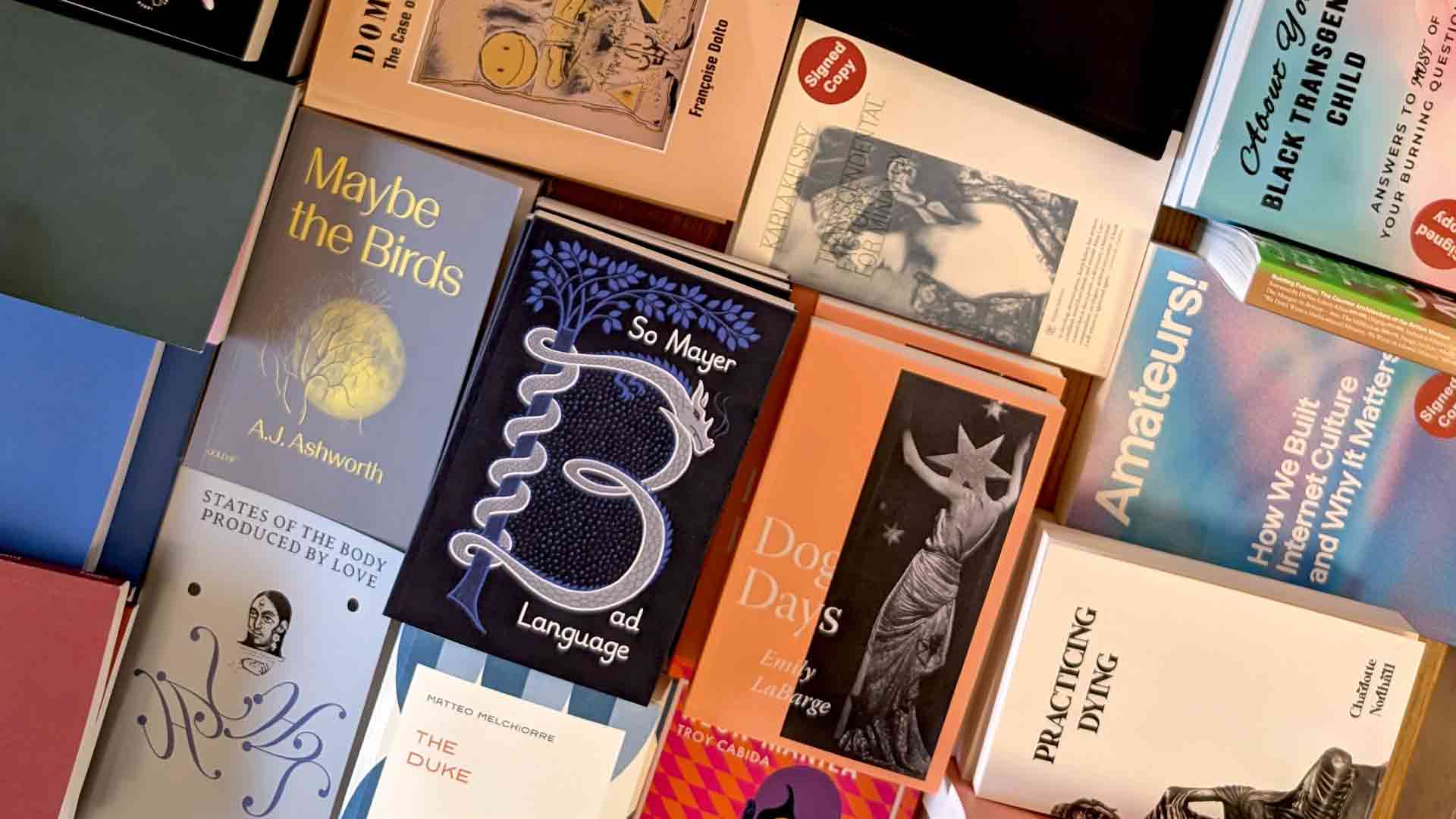
Fiction, poetry, non-fiction, hybrid books, artist books, broadsides, pamphlets, even vinyls and posters, beautifully written and beautifully printed. These are some things we could look at. Or I could say to you, small-press publishers are the spirit that animates our literature. And you might say – why, what do they do? For a start, small-press publishers put on the most community-led, exciting and engaging literary events, forming life-giving networks that sustain the industry at large.
So many writers, readers, publishers, agents, editors and literary professionals have met in these spaces. This integrative quality is reflected in these publishers’ deep understanding of their books – they are unique in publishing in that they are involved with every stage of production; from submission, to editorial, to production and distribution.
In terms of what they publish, small presses see within the wider publishing landscape market-led tendencies towards sameness and repetition, tendencies that they counter through the production of a diverse and imaginative literature. They are vital for the literary ecosystem in that they take risks on books that larger publishers would not; champion genre-bending and innovative forms of writing; pour time and energy into supporting emerging and overlooked writers; are dedicated to publishing books in translation; and tend to publish far more writers from minoritised backgrounds due to their networks, openness to writers from non-traditional literary pathways, and submissions processes. They are also dedicated to expanding the boundaries of the visual form of books through original approaches to design, layout and printing – despite the costs of complex typesetting.
Small-press publishers do all of this on extremely limited budgets, often without adequate pay themselves – and, in many instances, any pay at all. At the same time, their books are held to industry standard and compete with titles produced by big publishers: nominated for the same prizes, sold in the same bookshops and reviewed in the same publications. In sum, they are doing the same work as big publishers, only much more of it and for far less reward. Why?
As long as policymakers and the industry continue to flood money into AI, small-press publishers will only grow in stature and importance
The answer is not that they want to be unprofitable, but because of their love of literature. The books they make and the literary communities of writers and readers that they are integral to creating simply take precedence for them over profitability, and they make space to do this despite busy and pressured lives.
Small-press publishers’ passion for and understanding of literature, combined with the creative, diverse and alternative perspectives and spaces that they provide through their books, means that like an underground river they are a source of deep life for the literary industry. However, they are facing a severe crisis that is now draining them dry, down to the riverbed. On top of the lack of pay, which has always been unsustainable, the increasing scarcity of public funding combined with the ongoing impacts of the collapse of the Net Book Agreement, the reign of Amazon, and now the rising costs of book production are leading them to a critical tipping point. Soon they may no longer be able to publish at all, as a group of small-press publishers recently outlined in an open letter in The Bookseller. Many are already ceasing to do so.
It is for these reasons that small-press publishers are now looking to the wider book industry for investment and support: some ideas include skills and resource-sharing, and the development of a cultural impact study so they and the industry at large can build an in-depth argument for why innovative publishing is so important. They do not hold all the answers and are open to ideas. This could also include reforming distribution models that only serve large publishers (the remaining options cost them up to 25% of their annual net profits), shorter payment times from retailers, and making more space for their publications in a competitive landscape.
I want to make an additional case here for why the industry should invest in and support small-press publishers. While AI continues to be embraced by conglomerate publishing, one of the oft-cited arguments for why publishers should not use AI is due to its impact on the livelihoods of creatives; authors, illustrators and translators. Without going into the many troubling aspects of AI here, I have absolutely no doubt that the creative and pioneering writing, design and content of the books that small-press publishers produce simply cannot be, nor ever will be, replaced by AI. There is a market-driven and general conflation of the use of Large Language Models that produce chains of language based on habitual and familiar associations with the act of writing and creativity. The books that small-press publishers produce show us – more than any other – that writing itself is as much a process of thinking, one of creative-critical engagement with the world through which we reach new understandings; and that this thinking is collaborative as well as singular.
As long as policymakers and the industry continue to flood money into AI, small-press publishers will only grow in stature and importance. The quality of the books they produce, driven by that creative, alternative thinking and integrative design focus is only set to become more, not less, in demand. In addition, AI generated-books will not lead to community-led literary events that engage new readers and inspire writers. What will replace them? Nothing can, because people will always want to go to such literary events.
This December, industry professionals will be gathering together for the forthcoming FutureBook conference to ask – what is the future of the book? I believe it is in small-press publishing. It is time to extend them a hand.
Lucy Mercer will be in conversation with Kristen Vida Alfaro (Tilted Axis Press), Jess Chandler (Prototype), Sam Fisher (Peninsula Press) and Jack Thompson (Cipher Press) at the FutureBook 2025 Conference on 1st December. Book your place now.