




Picture books are crucial in helping kids understand AI
Today, children are eager to engage with big issues in a safe, yet ambitious way.


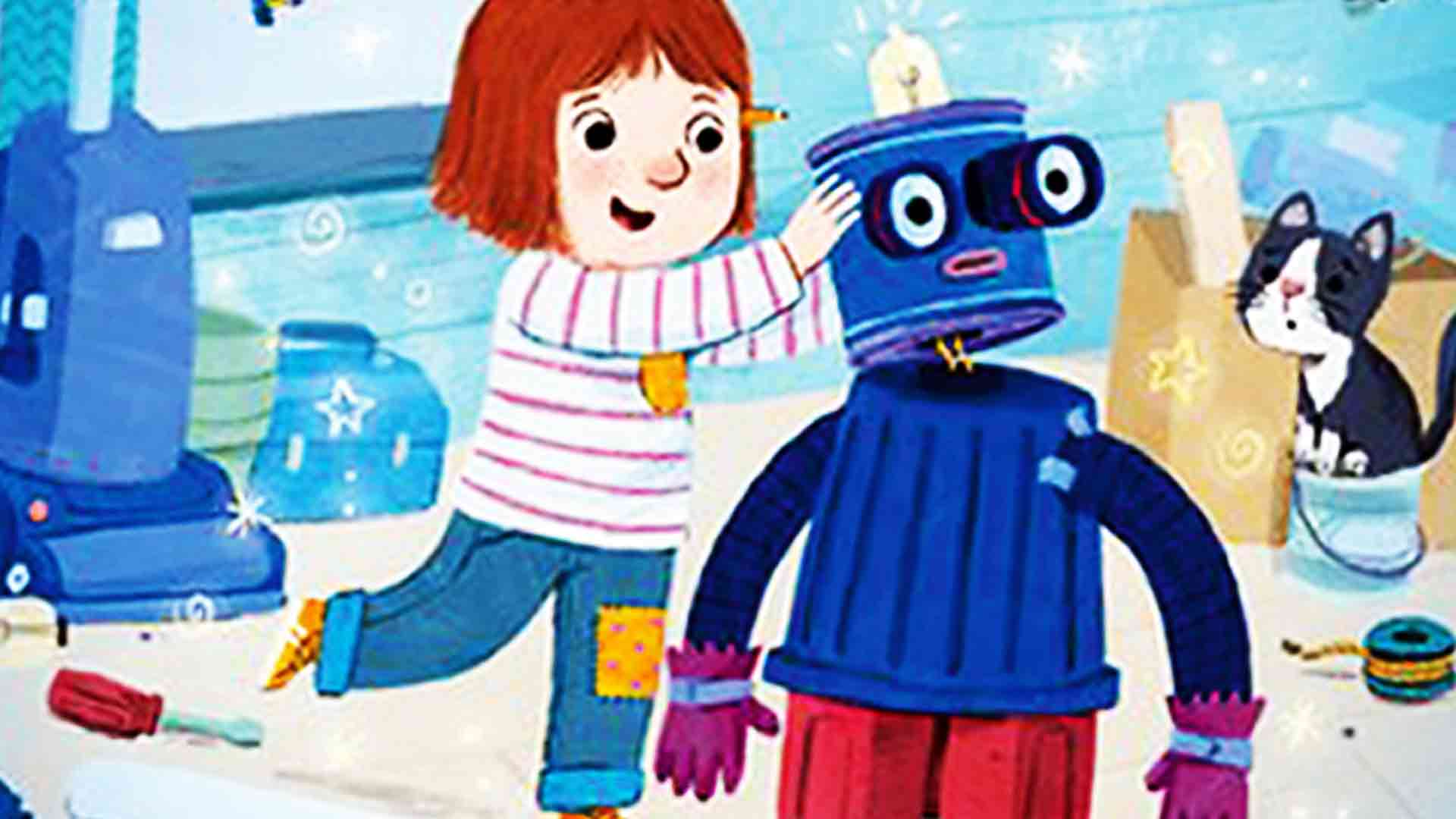
Our latest picture book, Bella Built a Robot, illustrated by Patrick Corrigan and published by Oxford University Press, is centred around a girl and her friend making robots. In the process, they discover the limitations of AI and technology in comparison to human imagination and friendship. As part of the book’s publication, we were able to visit many schools across the UK and share the story with hundreds of children. It was fascinating to see their reactions to it.
When we wrote Bella’s story, we wanted to explore the concept of AI in an accessible way for young children. Despite the challenges that AI poses to authors and illustrators, we wanted our exploration of the topic to be measured; children are undeniably excited by the possibilities it offers. Indeed, the term ‘AI’ was runner-up in the recent Oxford Children’s Word of the Year. They are growing up in a world where AI cannot be ignored, so we weren’t in the business of making it the bogey monster. We were keen to show its benefits and how we can use it as a useful tool, while underscoring how much more powerful and wonderful a human imagination is. Alongside this, we wanted to emphasise how real human connection can never be replaced by technology.
We also realised that the concept of AI is complex and therefore difficult and potentially overwhelming for very young children to understand. We wanted to find a balance that left children feeling empowered to explore ways technology can be used for good, but also to value and treasure their intrinsic humanity.
Of particular importance was embedding the idea, particular in really young children, that they do not need to defer to AI for everything; they have precious and powerful imaginations that are unique to them. Only recently, we asked primary-aged children to imagine a scene in an oral story and were met with the response “we don’t need to imagine that because we can get AI to do it”. Picture books are a perfect way to challenge these ideas from an early age.
We couldn’t have been happier with children’s responses to our book. They were instantly captivated by the idea of talking robots that can make cakes and play football and loved thinking about what they would ask a robot to do. They also loved the humour in Patrick Corrigan’s illustrations when the robots are utterly baffled by the idea of dressing up as part of imaginative play. When we broached the idea of the robots claiming that magic is not real, there would be universal uproar – in the imaginations of all the children sharing the book, anything was possible, including magic. In a lovely twist, many children were fascinated by the junk model robots we used as part of our presentation and were bursting to do their own junk modelling afterwards.
Picture books are often a shared read, in the presence of a trusted adult. This makes them feel safe and secure and reinforces the idea that human connection can’t be replaced
It might seem contradictory to use a physical picture book to explore such a cutting-edge concept like AI, but it is the perfect, accessible way to address pressing issues, such as the pitfalls of this new technology. Picture books are often a shared read, in the presence of a trusted adult. This makes them feel safe and secure and reinforces the idea that human connection cannot be replaced. The adult reader and child can pause, take their time to look at the illustrations in detail, and reflect on what they see in a way that is more difficult with a television programme or other medium. The child reader can also start to empathise with the characters and understand reactions to different situations.
There is no denying that AI is here to stay, so we can’t completely dismiss or condemn it. Whether we like it or not, it will inevitably be a huge part of the next generation’s lives. This came through loud and clear in the Oxford Children’s Language Report for 2025, where children were proactively writing about AI as a tool in their daily life. We can’t ignore the shift we see before us, but we can use books to navigate it; to show how AI can be a great tool, but it has limitations. And this isn’t exclusive to AI. There is certainly room for more picture books on other challenging, abstract topics to help grow children’s understanding.
For example, John Dougherty and Thomas Docherty’s The Hare-Shaped Hole tackles grief in an accessible and age-appropriate way, while their latest picture book, It Won’t Be Forever gently explores separation anxiety in young children. Many picture books are about refugees and displacement, for example Wendy Meddour and Daniel Egneus’ Lubna and the Pebble, while Helen Docherty and Taylor Barron’s Make It All Go Away recognises sensory overload. Kate Milner’s It’s a No-Money Day brilliantly illustrates the reality of poverty for young families. It is really important for picture books to cover the whole range of experiences a child might face in their lives.
At the end of our story, Bella and Riley instruct their robots to build them a den that they can use for all their magical adventures. “There is no magic in this construction,” Red Robot tells the children. “Not yet,” says Bella. “…with our imaginations we can always bring the magic!” And from what we can tell, everyone who has shared this moment with us feels relieved and thrilled about that.