






Seshni Jacobs on Hachette Learning’s curve
Three years into her role at Hachette Learning, and one year on from its rebrand, the schools boss’ division is looking abroad – and to the future.



Tom Tivnan is the managing editor of The Bookseller.
Tom Tivnan is the managing editor of The Bookseller.

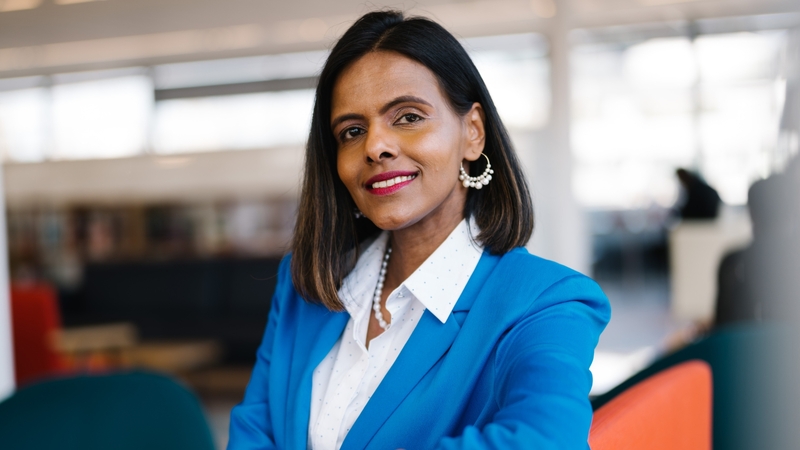
Recently, at the Education World Forum – the annual conference and meet-and-greet for schools policymakers and publishers – Hachette Learning’s CEO Seshni Jacobs was told by the higher education minister of Kazakhstan that she looked like a teacher. This was not out of the blue; Jacobs had mentioned her background – her parents were educators from entire families of educators, and she spent 13 years prior to making the shift to publishing working at the classroom coalface in her native South Africa.
“I couldn’t ask for a higher compliment,” Jacobs says. “I am a teacher and will always be a teacher. And I really do believe that if you get teacher professional development and teacher education right, it will filter down into learner outcomes. Plus, I’m cognisant that when I started teaching we had teacher training colleges, so we had a lot of practice, not just the academic. And that has largely disappeared in today’s environment.”
This is precisely why Jacobs has made professional development one of the main planks to build up Hachette Learning, the business that rebranded in autumn 2024 from Hodder Education. It was also one of her starting points when she was poached from Pearson by Hachette boss David Shelley to take over the division, following Lis Tribe’s retirement three years ago.
Jacobs explains: “I really felt that professional development was our core differentiator. We’re not a qualification body, so we’re not AQA, we’re not Cambridge, we’re not the IB [International Baccalaureate]. I couldn’t just say we have great content – we do, by the way – because everybody has great content; that’s your licence to trade.
“I realised that it had to be professional development, because I brought that expertise, and I worked ardently for two years with the team to get the mindset around professional development being our USP as a business, with curriculum and resources following that.”
Hodder Education had been one of the most venerable UK schools brands, having first started trading in 1868. (Another new industry startup, The Bookseller, was its neighbour on London’s Paternoster Row in the 1860s.) The transition to the Hachette Learning name was partly to underscore the metamorphosis from its print past to a digital present and future – a transition, to be fair, that had been happening before Jacobs’ arrival. Jacobs describes this as “a pivot to a solutions provider”.
Changing processes and systems is the easy part, it’s tick-box. The biggest challenges were the staff shift, the shift in culture. Because culture eats strategy for breakfast
“Solutions means great courseware, great assessment, great professional development, all underpinned by technology to enable the delivery. So, the digital transformation is not purely [about] making print books digital. Digital transformation is setting ourselves up to be able to deliver content in whatever format the customer requires it. We completely pivoted from being a publisher in the traditional sense of the word.”
Jacobs’ remit, which dovetails with the name change, was also to look further afield. This is partly because the domestic UK education market in general, particularly since Covid, has stagnated. Plus, while Hodder Education previously had a “small but successful” international side, the model was to primarily publish for the UK curriculum and to export that content abroad.
But, the Hachette brand can be leveraged in places where Hodder might not be so well known. Jacobs explains: “As I carried on with the transformation [to Hachette Learning], I realised that the credibility of having the support of this big name behind us will enable us to gain a presence and also equal footing with players like the Pearsons, the Oxfords, the Cambridges.
“It also allowed us to unify everything we did in the UK and [the US] Hachette Book Group. We have Hachette Children’s where we cater for libraries, so Hachette Learning can go in accompanied by our children’s portfolio. We have Jessica Kingsley Publishers that caters for special needs… this allows us to leverage what our parent company does.”
The above required wholesale changes in systems, processes and some personnel. Eight UK staffers were made redundant in autumn 2024, though Jacobs notes that Hachette Learning has made a number of hires since including a new technology department, international product managers and “a good leadership team with international experience”.
Continues...
Read More



Jacobs adds: “Changing processes and systems is the easy part, it’s tick-box. The biggest challenges were the staff shift, the shift in culture. Because culture eats strategy for breakfast; you can have the best strategy, but if the culture is not right you’re never going to be unified, you’ll never succeed. And at that point the business was still very successful and there I was coming in saying: ‘Look, we need to change.’
“I think one of the biggest problems we faced was the lack of complete understanding of the international market. We used to use a lot of agents and distributors internationally.
I wanted to change that and really wanted to get boots on the ground, because it’s only when you have your own people there that you can really hear what’s going on in the international markets. And these days, departments of education and ministries want to see UK businesses’ commitment to the local economy with local hires and local offices.”
The initial international focus was the “low hanging fruit” of the Middle East and those new local offices have paid dividends with a number of partnerships, including in Saudi Arabia, Jordan and the United Arab Emirates. Some of the newer priorities are in Asia – Vietnam, Thailand and Indonesia – and particularly in Southeast Asia, where, in countries such as Pakistan and India, “you can really achieve scale”.
One of the joys for Jacobs, even now, is getting out and about at teacher development days and conferences because, she tells me, teaching “is still my passion and if you ask anyone in the business, that’s my driver”. She might never have made the move into publishing if not for her compatriot Fathima Dada, then a Pearson VP, who “lured” Jacobs to the publisher with the pitch that she could make a bigger impact on the classroom “if I could create content and resources that supported the entire education industry”. (Dada is now OUP’s global MD for education.)
Jacobs’ career at Pearson included a number of senior roles in product development before she switched gears to business development, and she eventually ended up heading up that division for the East, Middle East and Africa.
All that background coalesced in her business’ two big tech launches in the past 12 months: Hachette Learning Adaptive and Hachette Learning Academy, which are both “innovative, personalised” platforms with the former aimed at students, the latter a professional development tool, both developed in partnership with Area9 Lyceum, a Copenhagen and Boston-based software company. Adaptive learning, broadly, is educational software designed to let students learn at their own pace.
These two products underpin Jacobs’ broad strategy: “What this means is we have to create content in a completely different way. Instead of creating a traditional textbook – because even an e-book is designed front cover to back cover – we now design millions and millions of learning objectives that go in as probes and can actually identify the pathways for the learners to follow, so every learner will go through the same content, but in a different way based on where they are on their journey.”
And this brings us back to the rebrand and the longer-term goal of keeping customers even after graduation. Jacobs says: “That word ‘education’ has a very K-12 schooling stigma. I would like to get to the opportunity where we provide ‘learning’ – for students, of course, but also for parents, for teachers, for leadership, for managers, all throughout their lives; that’s how I see Hachette Learning really evolving.”