

You are viewing your 1 free article this month.
Sign in to make the most of your access to expert book trade coverage.
Academia may in general be shifting to digital, but there is still plenty of common ground for physical shops and presses
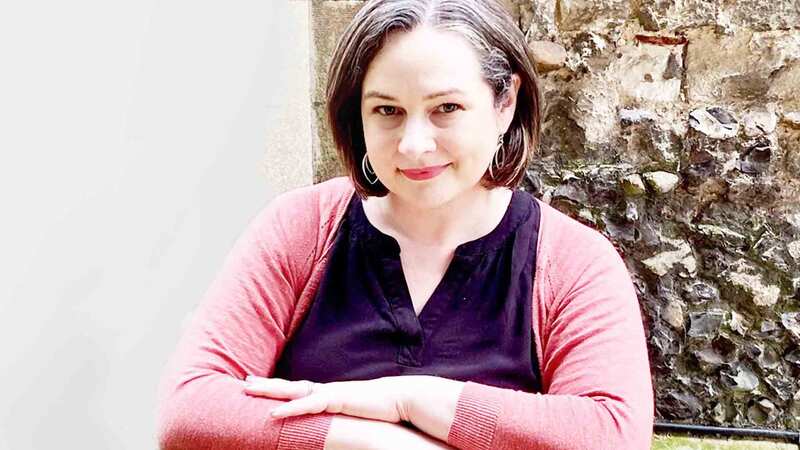
I catch Lighthouse owner Mairi Oliver just a couple of days after she and her team at the Scottish independent bookshop concluded the latest Edinburgh Radical Book Fair.
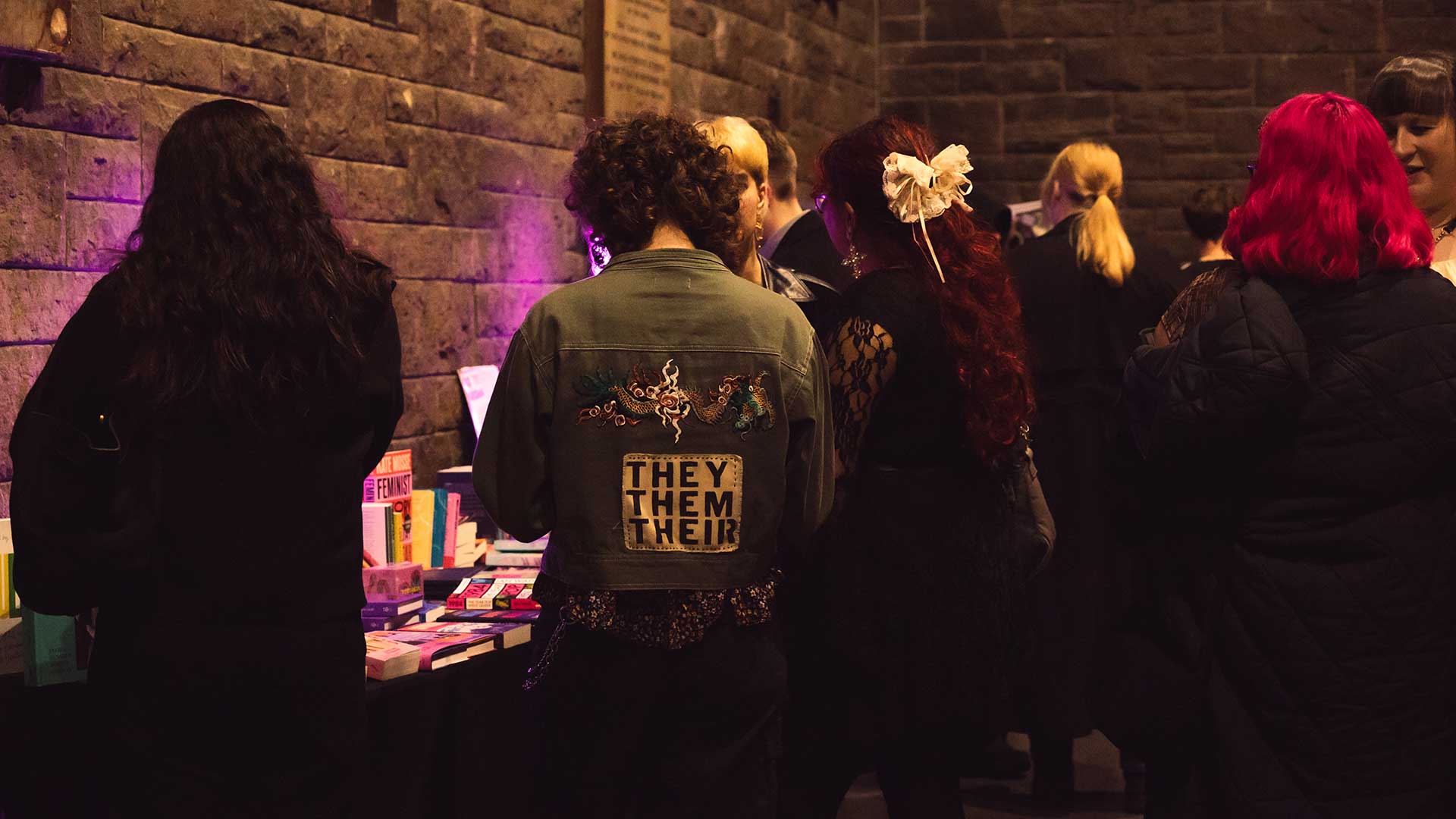
The 2025 edition of Lighthouse’s annual “festival of ideas” took place across four days in early November, encompassing more than 20 events with 60 publishers exhibiting their wares and nearly 3,000 people visiting the exhibition site at Edinburgh’s Assembly Roxy. Oliver says: “It’s kind of like one of the old-fashioned book fairs in that everything happens in one space. You can browse the publishers’ stalls and buy books while [house music legend] DJ Paulette is on the stage talking about politics and power. But it was really busy; the fair is sort of Lighthouse’s Christmas.”
A significant portion of the publishers at the fair, and a decent part of Lighthouse’s core stock in-store, are from university presses (UPs). This is at a time when the bulk of UPs’ revenue is deriving from, or at the least migrating to, digital. But the received wisdom that UPs are mostly deserting the bricks-and-mortar arena seems misplaced. For booksellers like Oliver, UPs are still playing a vital role for its audience.
“At an event like the Radical Book Fair, a lot of the trade indies get it, and the academic presses really get it,” says Oliver. “They understand the benefit of an audience interacting with the books in a different way. Customers are going to see every title face out, they are going to see the subtitles; it’s not a war with an entire bookcase of spines. So we’ll find that niche reader who is willing to spend on a book on a very niche topic. So the uni presses absolutely get it: they want to be seen, they want to help us find readers and they are willing to be creative in doing that.”
Lighthouse’s premises on West Nicolson Street is about 200 metres from the University of Edinburgh’s main George Square campus, so students, university staff and academics are a large part of the shop’s constituency. Yet Lighthouse does not offer textbooks – it refers students to the nearby Blackwell’s on South Bridge (which has long been Edinburgh’s academic bookshop powerhouse), as the chain can compete better on price. The focus instead, Oliver says, “is on the bits around the edges: the meaty stuff to go with your very specific dissertation”. Lighthouse does have a significant general audience, but with its positioning as an “unapologetically activist, intersectional, feminist, anti-racist, LGBTQ+ community space”, her shop’s usual customer might be different than elsewhere, says Oliver: “I suppose we benefit from being in a university town and our ‘average’ reader might, say, recognise [feminist scholars] Judith Butler or Sara Ahmed.”
Continues...
Oliver sees many UPs leaning into the crossover academic/general trade space and has had successes with a number of lists, namechecking MIT Press and Manchester University Press (MUP) – the latter in particular, as MUP is the publisher of DJ Paulette’s memoir, Welcome to the Club: “They are in on displays in pretty much every one of our sections, because they’re doing really great with the packaging and the price points.”
The high cost of UP titles in general can be an issue, though that has become negotiable. Oliver says: “Dialogue on price points makes a really big difference. Because UPs are going to sell most of a title to uni libraries, the price might come in at £29.99. Well, there could be interest for indie shops if that book was £18.99. And some of the good UPs are having those conversations with booksellers about what a general audience will pay for a book, and that makes a really big difference in our ability to stock it.”
‘The uni presses get it: they want to be seen, they want to help us find readers and they are willing to be creative in doing that’ – Lighthouse Bookshop’s Mairi Oliver
One of the exhibitors at the Edinburgh Radical Book Fair was the Mare Nostrum Group (MNG), probably the largest UP distribution, sales and marketing agency in the UK. MNG’s core UP business is selling and promoting North American presses outside of their home territories, with 67 houses on its books including Duke UP, Stanford UP and McGill-Queen’s UP (MNG also has many non-UP academic clients, including giants such as Sage and Human Kinetics, plus learned societies like the American Psychological Association).
MNG’s appearance at the Radical Book Fair was part of its boots-on-the-ground approach to its UP business, explains the group’s senior marketing manager Rachel Shand. She says: “We are kind of a bespoke service. We work incredibly hard, and it’s labour intensive to support our presses and their missions. But the presses are all different, so we can’t have a one-size-fits-all; they each publish in different fields with different numbers of titles. So we apply our marketing and sales strategies to them as individual publishers, rather than just across the whole 67.”
While it reps its university presses across formats – and sells directly to wholesalers, libraries and library suppliers, as well as e-tailers and bricks-and-mortar shops – print remains MNG’s UP stronghold, with 80% of its revenue in the UK coming from physical. A sizeable portion of its customer base is bricks-and-mortar bookshops, with MNG selling into 240 British and Irish indies this year, in addition to its large accounts with chains such as Waterstones.
Shand notes there is a level of curation when its staff approaches indies: “We encourage our reps to [approach] bookstores with our picks for them – for what is most relevant to a general audience. [Some UP titles] are, of course, really academic and a bricks-and-mortar store might not be the best channel.”
A big part of the MNG business with shops is facilitating events with UP authors, says publicity and marketing manager Nicola Mann. She notes recent successes during a very busy University Press Week, including a sold-out talk by McGill-Queen’s UP author Melissa Tanti, organised by Manchester’s Queer Lit, and a lecture series with London’s The Gilded Acorn Bookshop. Mann says: “We put in a lot of work for events, and that can run from small in-store seminars of 20 people to lecture theatres of more than 300 people.”
The Gilded Acorn is located off of the Kingsway amid London School of Economics’ (LSE) buildings, so students and academics are a large part of the customer base. But, the shop’s operations manager Hugo Jamison says, the business also caters to a mix of Holborn locals and a significant tourist and Theatreland trade.
Jamison says The Gilded Acorn has averaged about an event a week with UP-published authors in 2025, but has had particular success of late with sold-out turns from the likes of anthropologist Deborah James, international relations expert Joseph Torigian and economist Branko Milanović. He adds: “We have done a series of bigger-scale talks [with UP authors], using LSE and King’s College London theatre venues, and we felt this was a unique opportunity to elevate these sometimes quite niche titles that don’t often have the centre stage in more mainstream bookshops.”
While these events and in-store displays help platform The Gilded Acorn’s UP range, Jamison believes that a lot of presses could do more to boost sales. “I often get frustrated at the design,” he says. “Some are really good at covers – Princeton UP, for example. But there is room for improvement with most. As indie booksellers, we’re making decisions on bringing in stock on whether a book will sell. Of course, the content drives this but the design is a huge part, particularly in serious non-fiction. Some UPs may be letting their authors down by missing out on that crossover audience, as the covers don’t measure up to what’s inside the books.”