
The NHS doctor and ‘OBGYN Mum’ shares what she hopes to achieve with her taboo-busting guide to women’s health, Bloody Powerful.
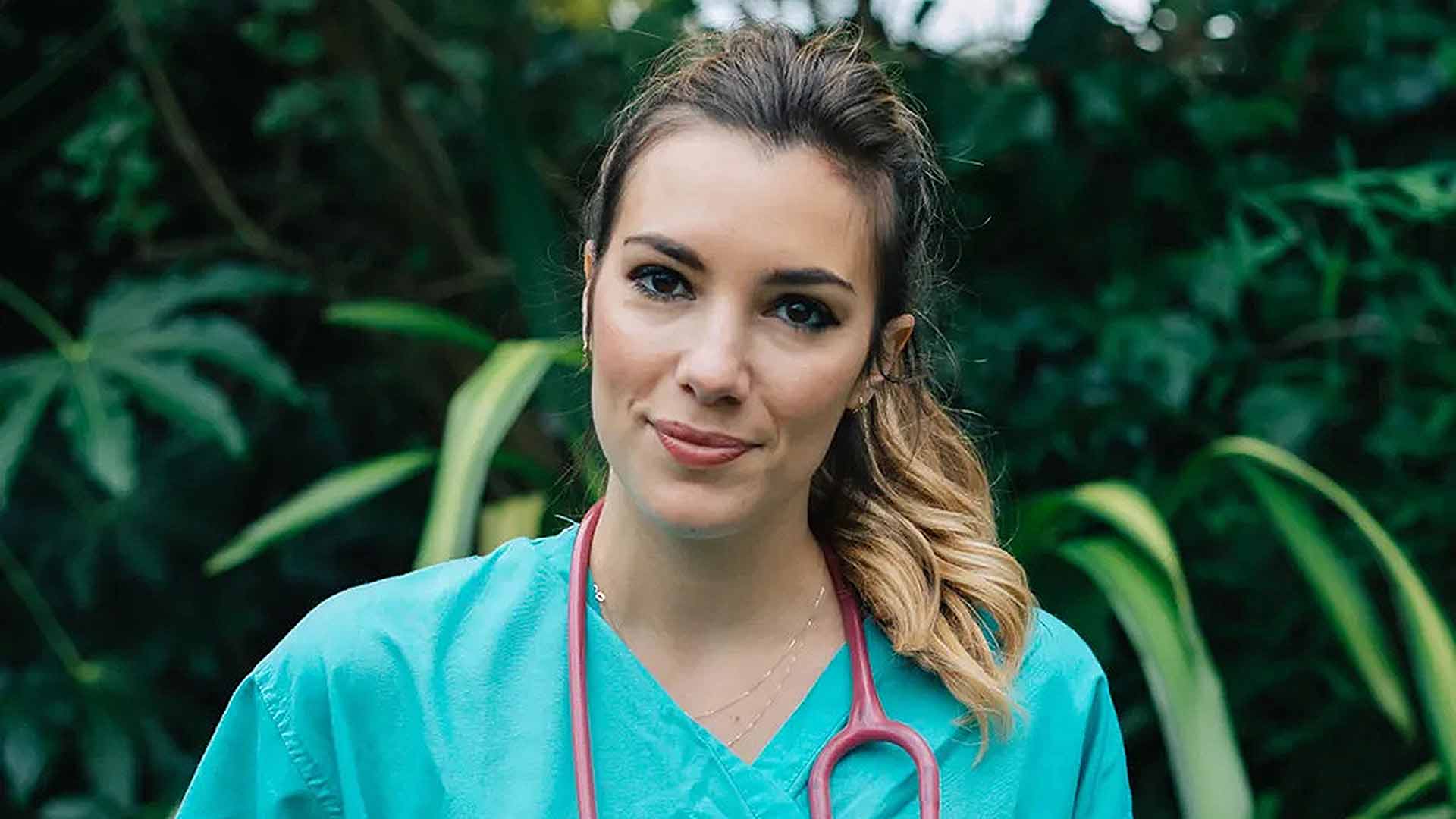
When Brooke Vandermolen, a London-based obstetrics and gynaecology doctor, started growing her family, she realised she knew more than was usual about what to expect.
“When I was pregnant, and a lot of my friends were pregnant, I realised I have a lot of privileged information because of the job that I do,” she explains. “Even though I was pregnant and having questions, wondering about the changes in my body, I knew the answers, or I was easily able to access the answers that I needed, whereas my friends were asking me questions that they wouldn’t go to their midwife for, or they wouldn’t necessarily book a GP appointment for.”
Vandermolen realised “they just wanted to understand more about their bodies, how it worked”. So she decided to start sharing what she knew on social media as “The OBGYN Mum”, posting about women’s health topics such as fertility, birth, contraception, hormones and more to her now 101,000 Instagram followers. Vandermolen’s social-media style is both friendly and authoritative when she talks about subjects as wide-ranging as why an IUD might fall out, tips for dealing with menopausal brain fog and how to discuss periods with boys.
Driven by the desire to demystify and myth-bust women’s health and tackle disinformation, a number of her videos react to unscientific claims from other creators – and presidents; a recent online post laid waste to Donald Trump and the MAHA (Make America Healthy Again) movement’s unproven claims that using paracetamol during pregnancy might cause autism in babies (the conclusion of Vandermolen’s post was that the evidence shows “paracetamol/acetaminophen remains the safest pain reliever for pregnant people when used as directed”).
There’s a big thirst these days for someone who can cut through misinformation. There are a lot of things that go viral that are not based on any kind of evidence. So it snowballed from creating content to needing to say more.
“There’s a big thirst these days for someone who can cut through misinformation,” Vandermolen tells me over Zoom, infectiously impassioned and enthusiastic despite having just come off a night shift. Vandermolen, who now has three children, received her medical degrees from University College London and currently works four days a week as an OB-GYN senior resident in UCL’s NHS hospitals trust. She says: “There are a lot of things that go viral that are not based on any kind of evidence. So it snowballed from creating content to needing to say more. This book is my way of saying: here are all the questions I’ve received or the things that people often want to know more about.”
Bloody Powerful: The Taboo-Busting Guide to Periods, Menopause and Everything In-Between – which is playfully illustrated in colour by Hazel Mead and scheduled for publication by Cambridge University Press in April 2026 – aims to include “the things you may not have covered in school“ and “explain [information] to you not in a way that treats you like a child, but also not in a way that treats you like you understand how to read a medical textbook”.
Vandermolen adds: “[The book] is somewhere in between the two, where we have really nice illustrations, which bring it to life and give it character and personality. And that’s always how I try to make content, to speak to people as they want to receive information these days.”
Bloody Powerful includes sections on “getting to know your body”, periods, sex and hormones as well as contraception, pregnancy, pregnancy loss and menopause, including, in the introduction, sections on biological sex and gender.
For Vandermolen, it was essential to ensure nobody was excluded by the guide’s terminology: “I try to tackle some controversy without offending, without opening up conversations, and there is definitely more to explore. One of the things I talk about right at the very beginning of the book is about when I use terms like ‘women’, and ‘people who have periods’. Framing that throughout the book took a lot of deep thought and consideration, and I looked at how other people who’ve written books recently have spoken to [readers]. Because I’m conscious that not everyone who needs this information about periods, about contraception, about sex, necessarily identifies as a woman, but they still may have a uterus and still may experience periods.
“But equally, when you talk to an audience and you talk about people who have periods, that also can offend other people who feel like women are being left out of a conversation. So I think that that type of issue definitely could be explored further. Where we landed on at the end of how to refer to everybody was my take on it.”
She writes in the introduction: “I want to briefly explain the interplay between hormones, gender identity and biological sex. Understanding this relationship will help clarify the language I use throughout the book and why I sometimes refer to specific genders or biological terms when discussing certain aspects of health.
“I want to acknowledge that this is a work in progress. I don’t claim to have the perfect approach, and I am continually learning from people across different communities. My goal is to use language that feels appropriate to those it relates to, while ensuring no one feels excluded. I hope this book reflects an effort to present evidence-based information with thoughtfulness and inclusivity.”
Ultimately, Vandermolen hopes the book can be a trusted reference point for people at different stages of their life, to be shared and flicked through, rather than something overtly political. In recent years, she says “there’s [been] some great focus on certain key issues”, such as the menopause, but “it’s still quite highly politicised, and a lot of the information is still kind of skewed. It’s not necessarily the overview that somebody wants. We talk about certain things, but often from an angle, right? Similarly, for example, endometriosis, we talk about it more than we did before but, sometimes, it assumes a level of knowledge that people may not have”.
Continues…
Instead, Vandermolen sees her book as an “overview”, as “something that sits on your coffee table that, when you first get it, you hopefully leaf through it, you pick out some of the information that might feel interesting at the time, but then you might come to a certain chapter in your life, when you’re just thinking about maybe trying for a baby soon, but you don’t really know even where to begin”.
She also adds that Bloody Powerful is “easy for a man to digest, it’s easy for you to talk to your daughters about, [and] if you’re starting to go through the menopause, or someone in your life is starting to go through the menopause, you can just turn to it and understand, actually, what is it? What can someone expect, and how can I be supportive to them as well? I see it as a reference point. You could go to ChatGPT, but ChatGPT will also give you a lot of rubbish. Here, it’s given to you by a doctor, it’s evidence-based and we’ve provided references”.
This rigour made Cambridge University Press the perfect home for the book, Vandermolen explains, rather than a more trade-focused house. The press still employs, as it has since 1698, the “Syndics” – a group of academics whose duties include ensuring that each title measures up to the university’s scholarly standards. Vandermolen adds: “I’ve loved working with Cambridge University Press, because it understands scientific references. It understands working with doctors and the way we think. But I think this is one of its first forays into an area that’s not necessarily directed at medical professionals. This is directed at the general public, but it’s me bringing that evidence and scientific basis to you.”