
The award-winning author on the mischievous protagonist of her new novel, Helm – a Cumbrian wind whose days could be numbered.
Helm (Faber), the latest, wondrous novel by two-time Booker nominee Sarah Hall has been in the works for 20 years; a mere blink of an eye for its ancient, playful, hilarious, destructive and – potentially – dying main character, Helm “helmself”.
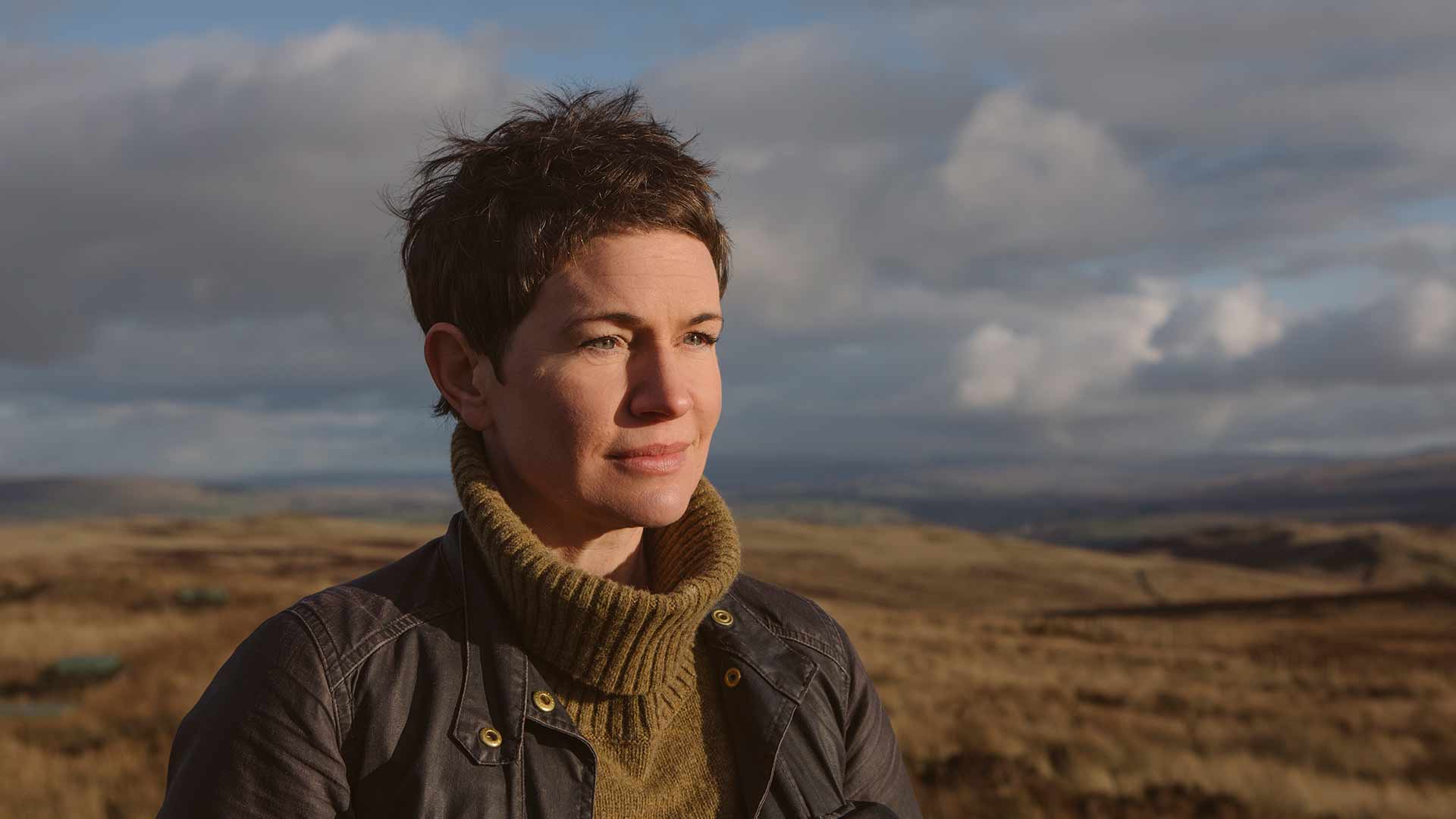
Hall is from the Eden Valley in Cumbria, where the novel is set, and grew up with Helm, the only named wind in the UK, described by the Met Office (who were “great” in helping Hall in her research for the book) as “a strong north-easterly wind hitting the south-west slopes of Cross Fell in Cumbria”.
When the wind blows, a heavy bank of cloud rests along or just above the Cross Fell range, the Met Office description continues; “a slender, nearly stationary roll of whirling cloud (the ‘helm bar’), parallel with the ‘helm’, appears above a point one to 6km (up to three miles) from the foot of the fell”.
Hall would frequently see these clouds as a child, she tells me when we talk over Zoom. “The little hill next to my parents’ house, you’ve got a straight shot looking over to Cross Fell, so you could see the two clouds, you could see it happening. It was a local phenomenon that everybody knew about,” she explains. “I’d always been really interested, I was a geeky kid that loved all the weather stuff, so really early on, I think probably even the first two-book deal that I set up with Faber, which was around about 2004 or 2005, I said I really want to write this book, and it had a different title, [but] I just couldn’t do it because there are so many stories. I didn’t know which ones to choose and what to leave out.”
Over the years, Hall experimented with different ways into the story – “I kept coming and going, [thinking] okay, maybe there should just be three solid stories that overlap from different eras”. It was when Hall began to envision Helm as a character in its/their own right – the novel perpetually challenges the way we relate to natural phenomena, like Helm, in much the same way as Robert Macfarlane in his recent book, Is a River Alive?, mentioned by Hall during our conversation – with the potential for play, joy, humour and communion, that the book, and Helm, began to come to life.
“Suddenly I thought, right: biography. Well, I’m not going to write a biography, because I’m not a non-fiction writer, but what a fun idea, a kind of creative biography,” Hall explains. “And then I landed on this idea of, well, shouldn’t the wind tell its own story, as well as saying, ‘Oh, look at all these marvellous stories about me?’”
The resultant novel is still polyphonic, following the interwoven stories (some taken from real life, others speculative) of, for example, neolithic Na-Nay, a woman whose life is devoted to finding a magstone she saw in a vision on the mountain as a girl, which eventually results in the erection of the Long Meg and her Daughters structure that stands in Hunsonby – “a massive stone circle in the Eden Valley, which nobody knows about, but it’s as big as Stonehenge”, Hall says.
The one thing fiction can do is make people live an experience. I’d love to just be able to give somebody that experience of a natural phenomenon in some capacity and have them think about it
Other characters and storylines include that of Dr Selima Sutar, a contemporary researcher who fears Helm’s end is nigh, and Janni, a young girl growing up in the middle of the 20th century whose wild nature and visions of her friend, Helm, see her sent to a psychiatric facility. When she comes back, she has forgotten Helm, but Helm is determined to help her remember. And then there is Thomas from the Royal Meteorological Society (“A usurper of nature, a vulgar industrialist” in the eyes of Mrs Brooke, his wife’s cousin); as well as Michael Lang, who is based on Scottish mathematician and scholar of the Middle Ages, Reverend Michael Scot, “who was an alchemist, wizard priest”, and in the novel attempts to scale the mountain carrying a crucifix.
Through these narratives, Hall charts the many ways humans have related to and mythologised Helm, the pagan and the Christian, the ways people have tried to control and understand the wind, commune with and exorcise it. Omnipresent and at the heart of these human dramas is Helm, who Hall envisions as a character like Puck from Shakespeare’s A Midsummer Night’s Dream – “a really naughty, disingenuous, but somehow actually quite moving narrator”.
She explains: “The more I researched all these stories, the more I thought [Helm] could be a really funny character, because wind demons were considered to be perverts in King James I’s Demonology. And I was like, ‘oh, that’s brilliant’. I also liked the idea about Helm liking fart jokes. And I thought, well, this is such an extreme issue – of an end date for this marvellous phenomenon – that it can’t just be all doom and gloom, because I’ve done doom and gloom, and I do doom and gloom all the time.” The character of Helm opened everything up: “I thought, ‘oh, my God, I could just do anything. How amazing, to feel like I can do anything again. And actually, why not try and be a bit funny?’”
Hall continued: “Once the Helm’s been named, that’s it. There’s a personality there. There’s an identity, a meaning, but it is refracted through human beings. So, you have to have all the human stories around it. And it always just comes back to us. Because ultimately, how do we apprehend and think about natural, elemental things that are alive and in theory should have rights? […] We need to go back to thinking in a more integrated way, because we’re human animals, we’re not human beings, and we live in an ecosystem.” Hall would love for the book to have an environmental impact. “[Fiction] doesn’t work in the same way that a Robert Macfarlane book about river rights is going to make people think. But the one thing fiction can do is make people live an experience. [I’d love] to just be able to give somebody that experience of a natural phenomenon in some capacity and have them think about it. What I’m always trying to create is a human, sensual experience, that embodiment, where you’re connected with the world. This is a book that’s been made of a whole load of human experiences. It’s a very sensual, biological book. What I would like people to feel is ‘enhumaned’.”
Imprint Faber
Publication 28th August 2025
Formats Main edition HB (9780571383559, £20); indies exclusive edition HB (9780571397310, £20); export trade PB (9780571383566, £14.99); EB (9780571383573, £9.99)
Rights sold UK Commonwealth and EU, excluding Canada
Editor Alex Bowler
Agent Tracy Bohan, The Wylie Agency